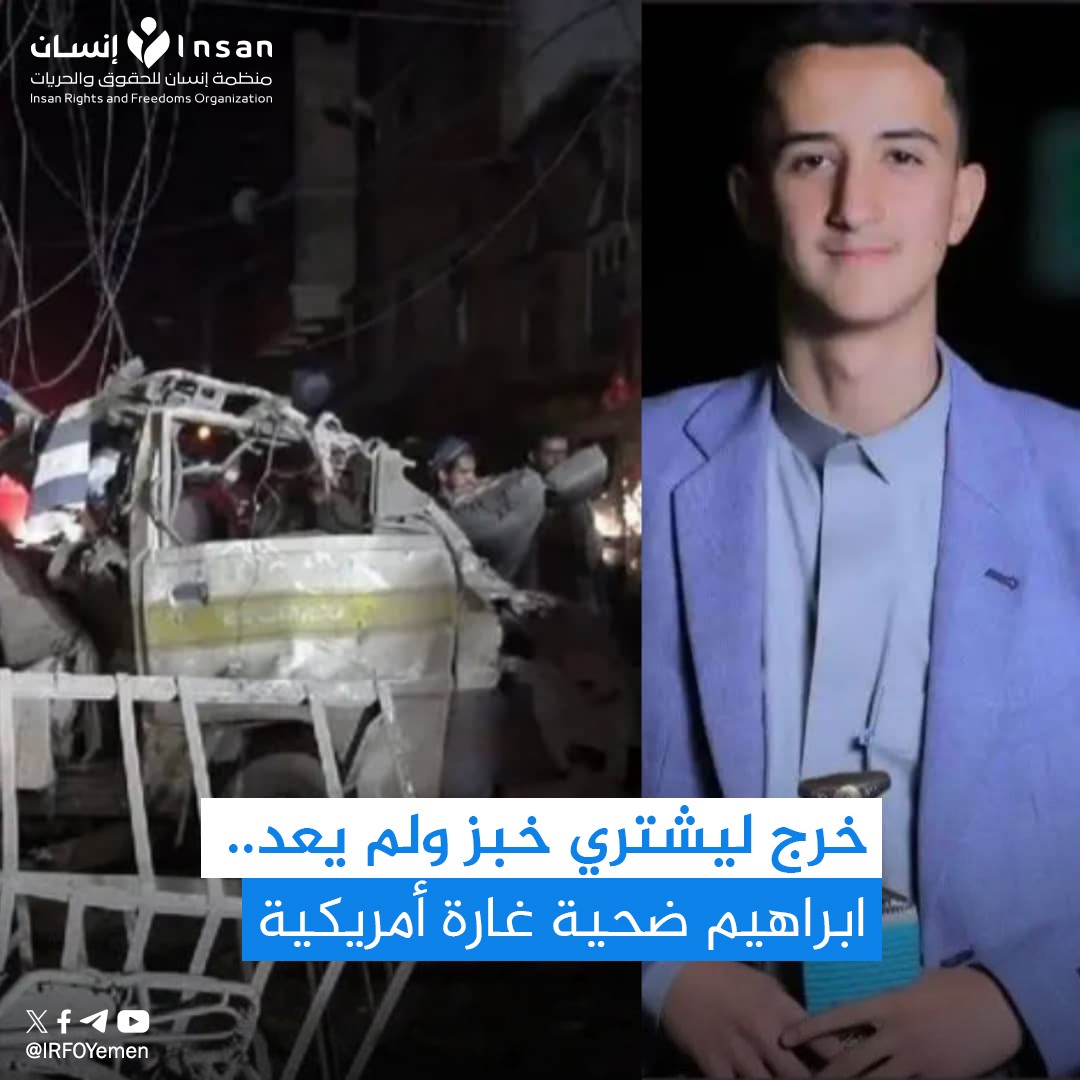
Yesterday evening was not an ordinary one. At first, it carried nothing but the scent of fresh bread. Ibrahim left his home in the Shaoub neighborhood of Sana'a, holding in his hand the money his mother had given him.
He bid her farewell with a smile, hoping to see her again in a few minutes, and headed to the popular Farwah market, where he usually bought bread from the same small bakery known to everyone.
He didn’t know that those simple steps would be the last in his life’s path, that the dreams he played with to pass the time would be burned, and that his meeting with his mother would be delayed.
After he reached the bakery, an American missile shook the sky of the area—and the sky of Sana'a. A moment of deadly silence followed, and then the market turned into a hell of fire, dust, and blood.
The bakery burned... and with it, the dream. Ibrahim was martyred, as was the bakery owner. Nothing remained of them but blood soaking the stones of the market.
Cries of people filled the air. Everyone was running, searching for loved ones under the rubble. Among the screams, one cry pierced through the wall of sound and conscience—a woman’s voice, and a small child clutching a blood-stained piece of cloth, perhaps from his father or brother. He whispered with a voice choked by tears: “O Lord, let it be a dream… O Lord, let it be a dream.” And the woman echoed loudly: “O Lord, let it be a dream… O Lord, let it be a dream.”
But it wasn’t a dream—it was the brutal reality of American savagery.
That cry wasn’t just pain—it was a summary of an entire nation living under bombardment, where children are buried before their dreams.
A cry from Sana'a, heard in distant Gaza... as if the pain between them is one road, walked silently by the souls of the martyrs, carrying one message: We are victims of American arrogance, victims of the Pharaoh of our time.
Ibrahim’s story is not the end… but the beginning of a nation’s tale, trying to stay alive, despite all efforts to erase it.
Yes,
Ibrahim was martyred, the baker too, and dozens of civilians. The market will remain a witness to the American crime.
The woman’s cry and the child’s sob will haunt the one who straightens his headdress in the mirror before heading out to a night of laughter, dancers, and imported liquor. It will haunt all who sleep under warm roofs, sipping their morning coffee while holding their phones, justifying the killing and absolving the killer—while the children of Sana'a and Gaza carry their shrouds in their tiny hands.
Ibrahim will no longer buy bread,
but the curses of silence and justification will follow you
for as long as the earth remains.